.png)
Hunter Wetlands Centre honours veteran volunteers with Life Membership

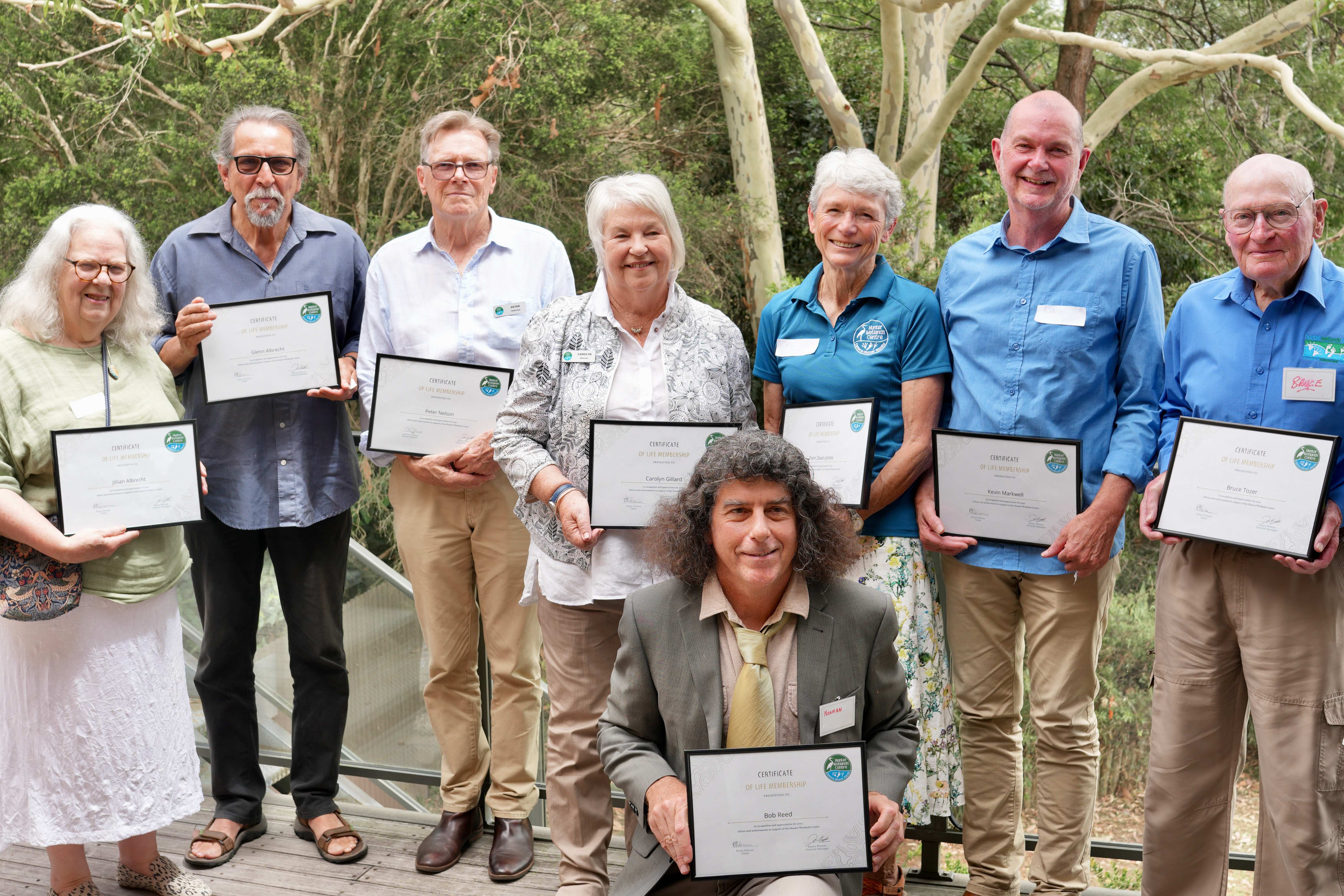
On 24 November 2025, at a morning tea held on the deck overlooking the very wetlands that they helped to rehabilitate, eight remarkable individuals received Life Membership in recognition of their long-standing service to the Hunter Wetlands Centre.
Glenn Albrecht, Pam Dean-Jones, Carolyn Gillard, Kevin Markwell, Dr Peter Nelson and Bruce Tozer each received their Life Membership awards in person, while Norman Reed accepted the posthumous membership on behalf of his father, Bob Reed. Jillian Albrecht, who received her Life Membership in a ceremony earlier this year but was unable to attend the function, was also handed her certificate.
Through their passion and perseverance, these Life Members have helped shape the evolution of the Hunter Wetlands Centre to become the internationally significant site it is today. Their contributions, which span conservation, research, education and community engagement, have expanded our knowledge of wetland ecosystems and fostered greater appreciation for them in the wider community.
We thank Glenn, Jill, Pam, Carolyn, Kevin, Peter, Bob and Bruce for their time, dedication and willingness to go ‘above and beyond’ to ensure the success of the Hunter Wetlands Centre and inspire ongoing education and protection of wetlands for generations to come.
Glenn Albrecht
In 1981, when Max consulted Kevin McDonald and Wilma Barden on the curiosity of egrets nesting in Melaleuca Swamp, Wilma brought with her a newly arrived environmentalist from Western Australia. Glenn soon found himself as a foundational member of the inaugural Steering Committee in a campaign to save the last remaining wetlands of Shortland.
Passionate about the environment, Glenn threw himself into the formation of the Hunter Wetlands Centre. One of his earliest roles was as the first Secretary of Membership Services, helping to swell Member numbers to almost 2000 before the Centre had even opened. He also held positions on the Hunter Wetlands Trust Council, Shortland Wetlands Centre Board, Bird Research Committee and led many working bees and field excursions both at our Wetlands and in the greater Hunter Estuary.
Although his notable career in environmental philosophy has taken him away from the Hunter region, he remains a supporter of the Hunter Wetlands Centre and was a speaker at our 40th Anniversary Gala Dinner in 2024.
Jillian Albrecht
Along with her husband Glenn, Jill has been a staunch supporter of the Hunter Wetlands Centre since its conception in the early 1980s.
Jill’s skills in editing, writing and publishing were quickly put to use on our early newsletter and, later, the Wetlander magazine. In those days, the Wetlander was a quarterly publication of over 20 pages covering building projects, fundraising initiatives, visitor experiences and wildlife topics. Working with her husband Glenn, Max Maddock and a team of contributors, Jill was responsible for not only compiling the Newsletter but typing, printing and posting it out to a membership of over 2000 people.
Jill’s work on the newsletter goes beyond ‘keeping the membership informed’. The Wetlander is an incredible historical record of wetlands conservation and research, ensuring that our conservation journey has been well documented for future generations.
In addition to editing the Wetlander and while raising her own children, Jill became a surrogate egret “parent” for abandoned chicks from our Melaleuca Swamp colony. Hand-feeding the chicks a diet of fish-flavoured cat food, worms and other natural foods, Jill ensured that chicks were raised to fledglings and were able to rejoin the colony.
Pam Dean-Jones
Pam first encountered the Hunter Wetlands Centre in 1985 when she brought a group of TAFE horticulture students to the newly acquired site to meet Brian Gilligan and hear the vision for its restoration. After learning she knew a little about wetland sedimentary history, Brian invited Pam to join the Hunter Wetlands Trust.
Part of the role of the Trust was to contribute to emerging environmental policy, planning and management. In 1990, Pam became President of the Trust, representing the Centre locally and internationally, strengthening relationships with wetlands organisations worldwide, and advocating for the protection of wetlands across the region.
With qualifications in geomorphology, archaeology, and planning, Pam has a distinguished career in coastal policy, planning, and management, working across government, consulting, and numerous committees and task forces. As Pam neared the end of her consulting career, she returned to support the Hunter Wetlands Centre and, in 2025, joined the Board and the Scientific Committee. She currently represents the Hunter Wetlands Centre in the development of the Hunter Estuary Coastal Management Program.
Carolyn Gillard
Carolyn vividly recalls her family arriving at the newly purchased site on the 24th of November 1985 for the Centre’s first working bee. She has continued to be involved with the Centre in some capacity ever since, making her one of our longest-serving individuals.
In 1992, Carolyn took up a teaching position at the Wetlands Environmental Education Centre on site, teaching wetlands ecology to primary and high school students, running visual arts workshops for high school students, co-authoring environmental units for K-Year 4 students as part of the HSIE syllabus and running environmental education conferences for teachers. Her role at the EEC lasted more than two decades.
A current Director of the Board, Carolyn continues to be active in the day-to-day decision-making at the Centre. She also continues her longstanding commitment to community engagement and education as a Guide promoting the history, conservation and beauty of the wetlands. Carolyn’s horticultural knowledge of Australian Native Plants has guided the design and ongoing care of our Sensory Trail and Bush Tucker Gardens, leaving a lasting imprint on the visitor experience.
Kevin Markwell
Kevin Markwell was drawn to the Hunter Wetlands Centre in 1985 while a graduate student at the University of Newcastle. An environmental ‘jack of all trades’, he was involved in all aspects of the Centre from conducting fauna surveys, habitat assessments and co-authoring papers to coordinating interpretation and visitor experiences, including developing the “Young Wetlander” out-of-school educational program. He also held the role of Research Liaison Officer, strengthening our ties with the University of Newcastle and research institutes.
While at the Wetlands Centre, Kevin authored papers on environmental education, engagement and nature-based tourism. Since leaving the Hunter Wetlands Centre in 2003, Kevin has pursued an academic career spanning ecological research and tourism, with much of his work sitting at the intersection of the two.
Although no longer Newcastle-based, Kevin has continued to be an enthusiastic supporter of the Hunter Wetlands Centre. His legacy remains in our informative nature-based activities, particularly those that engage the young people of Newcastle.
Dr Peter Nelson
Peter’s initial involvement with the Hunter Wetlands Centre began when it was still merely a concept and a campaign to obtain the site. As a foundation member of the Centre and Council member of the Hunter Wetlands Trust. Over the years, he has been part of bringing that vision to fruition in capacities from research officer, to representative and delegate to his current role as Chair of the Board of Directors.
From 1991 - 2001, Peter was employed by the Centre’s environmental consultancy “SWC Consultancy”. Working out of what is now the National Parks and Wildlife Service building, the Consultancy provided environmental planning and management advice to the government and private sector. The work performed by the Consultancy was influential in the conservation, rehabilitation and use of our state’s wetlands. Although work took Peter away from the Hunter region, he was never far from wetland environments, working as Environmental Advisor for the NSW Department of Planning.
Peter’s retirement brought him back to the Hunter Wetlands Centre, taking up a position on the Board which he chairs today. Always keen to promote the Centre’s research credentials and potential, Peter has worked on the Green & Golden Bell Frog research project with Newcastle University and continues to represent the Hunter Wetlands at conferences and on committees.
Bob Reed
In the mid-1980s, the Hunter Wetlands Centre became actively involved in field research projects that significantly added to our understanding of wetland bird species, particularly bird behaviour and movements. From 1986 until 1996, Bob coordinated the Old World Warbler Project, which involved a team of 31 volunteers banding and tracking the movements of many of the wetlands smaller bird species. These included Australian Reed Warblers, Southern Emu Wrens, Sacred Kingfishers, Fairy Martins, Red-browed Finches, Silvereyes, Pipits and Superb Fairy Wrens. Using mist nets, the team banded more than 500 birds over 38 sessions. His regular Wetlander column, “Reed Warblings” kept the Membership updated on the project and findings.
Bob’s talents were not confined to studying bird life. He was a member of the Hunter Wetland Trust Council, helping to craft many of the policies we use today. Bob was also handy with a paintbrush, both to improve the appearance of our buildings as well as artistically capturing the scenery.
At Monday’s ceremony, Bob’s son Norman, who accepted the posthumous Life Membership on his father’s behalf, presented the Centre with a painting by Bob of a wetlands scene.
Bruce Tozer
Somewhere in his busy schedule of voluntary work, Lake Macquarie-based Bruce Tozer finds time for the Hunter Wetlands Centre.
Since joining us in 2011, Bruce has become an established member of our Tuesday and Thursday Mobs. He also served as a member of the Board for several years.
Bruce is passionate about working with disability groups and has spearheaded a number of inclusivity projects at the Hunter Wetlands Centre, such as the “Count Us In” project with Newcastle City Council and the development of our Fishing Platform (which would not have been possible without his knowledge and connections as an angler). With Bruce’s ability to navigate small grants for impactful projects, we have been able to make wetlands accessible and enjoyable for a broader range of visitors and volunteers.


.jpg)
.jpg)